
Why Are We Trialling 55 Players When We Only Need Five?
6 minute read
Trial season is approaching again in Western Australia.
For players, that often means moving from one club to another, sometimes trying to attend several trials in the same week — or even on the same night. Parents are expected to make decisions quickly, often without knowing what other opportunities may still exist. Meanwhile, coaches, Technical Directors and volunteers are attempting to assess dozens, sometimes hundreds, of young players over a handful of sessions.
We have come to accept this as normal, but normal does not necessarily mean effective. If recruitment is supposed to build better squads and place young players in environments where they can develop, there has to be a smarter way.
Start with the squad, not the trial
Imagine that instead of beginning recruitment with an open trial, a club begins with an honest assessment of the squad it already has.
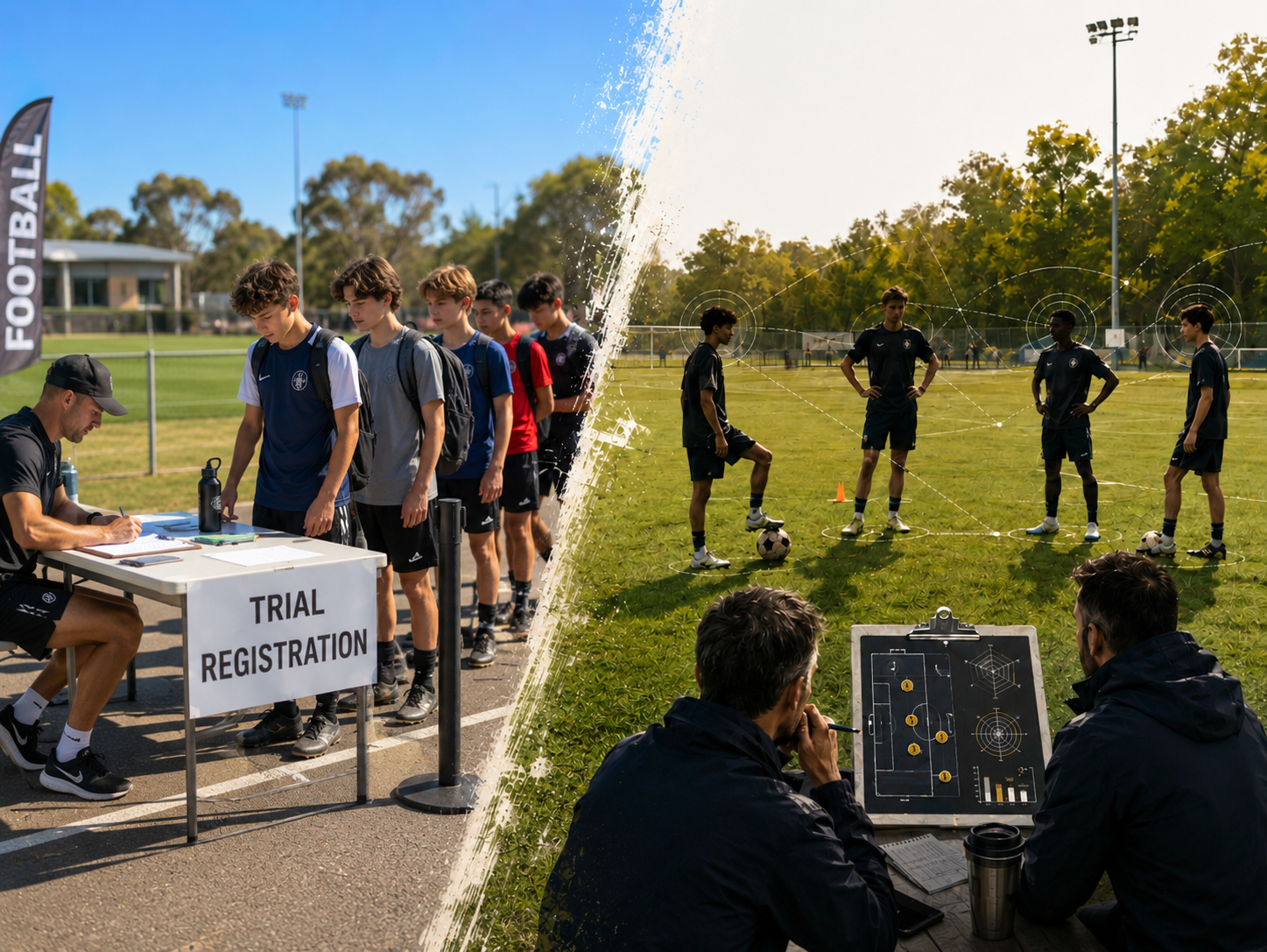
Through a combination of coaching observation and measurable performance data, the club identifies where it is strong, where it is vulnerable and what attributes are missing.
Perhaps the squad needs a centre-back. Not simply a centre-back, but someone with good acceleration because the team plays with a high defensive line, strong positional awareness and reasonable balance between their left and right foot.
The club also needs a defensive midfielder with a high work rate, good endurance and the ability to receive and release the ball quickly. A naturally left-footed winger would improve the balance of the squad too, although that is preferable rather than essential.
Now recruitment has a purpose. Instead of announcing: “U15 trials. All players welcome.” The club can say: We are looking for a centre-back, defensive midfielder and potentially a left-footed winger with these characteristics.
Expressions of interest can help identify players who appear to match those needs. Perhaps five are invited, not 55.
The data gets them into the room. The coach decides who stays.
This does not mean selecting footballers from spreadsheets. Acceleration can be measured, work rate can be measured, foot usage, physical output and aspects of technical performance can be measured.
But can a number tell you whether a centre-back recognises danger early enough? Whether they communicate? Whether a midfielder understands when not to press? Whether a player responds positively after making a mistake?
That is where coaching experience and other types of data matters but in any case, the purpose of data is not to replace the eye test - it is to make the eye test more focused, more informed. Instead of asking coaches to identify three suitable players from 55 strangers wearing numbered bibs, the process has already done some of the filtering. Coaches can properly assess a smaller number of players who appear to possess the characteristics the squad actually requires.
Put them under pressure. Watch their positioning and decision-making. Coach them and see how they respond. Observe their communication and behaviour around teammates.
The data gets the right players into the room, the coach decides who stays there.
But recruitment is only half of the decision
There is another side of trials that we rarely discuss, we treat them as though the club is choosing the player.
The player and their family should also be choosing the club. That matters because putting a player into the right environment is itself a development decision but junior football regularly confuses status with development.
Playing a year above your age sounds impressive. Joining the club that wins every weekend feels like progression. Getting into a highly regarded team can become an achievement in itself. Sometimes those things are beneficial, sometimes they are not.
A player competing a year up may be appropriately challenged, or they may spend the season physically surviving rather than developing. A player joining a dominant team may win regularly but receive limited opportunities to solve difficult problems. Another may join a prestigious squad only to discover that three established players already occupy their position.
They have moved to a "better" club but have they moved into a better development environment?
Confidence and enjoyment matter too
There is another consequence that is harder to measure but impossible to ignore.
Confidence.
Young players do not develop in a straight line. Form changes, bodies develop at different rates, players lose confidence, regain it, become overconfident, lose interest and sometimes question whether they want to play at all.
Much of that is a normal part of junior sport. The wrong environment can make it considerably worse.

A player pushed too quickly into a level above their current capability may initially enjoy the status that comes with it. Then training becomes harder, touches become fewer, mistakes get punished and weaknesses that were previously hidden are exposed.
Challenge is necessary for development, but that has to be coupled with the right challenge at the right stage of development supported by the right environment and coach.
If a player is constantly surviving rather than succeeding, confidence can disappear remarkably quickly. So can enjoyment.
The opposite can also happen. A player who has always dominated at a lower level may develop an inflated view of where they are. Moving into a stronger environment can expose weaknesses they have never previously had to confront.
That isn't necessarily bad, in fact, it can be an important part of development. The question is whether the environment supports the player through it.
We also hear plenty of stories about young players who have supposedly "dropped down a level", only to rediscover their confidence, get more touches, take greater responsibility, play more minutes and start enjoying football again.
Before long, they are improving again. Was dropping down really a backwards step or was it the development decision they actually needed?
Sometimes the best environment is not the highest level a player can possibly survive in. It is the level that provides the right mixture of challenge, opportunity, success, failure and enjoyment.
What does the player actually need?
Development depends on far more than the badge on the shirt. It depends on playing time, appropriate challenge, coaching quality, position, role, training standards, opportunity, confidence, enjoyment and the relationship between what the player needs and what the team needs.
Consider a talented striker joining a squad that already has three established strikers. They may spend most of the season fighting for minutes.
At another club, that same player might be the missing piece of the squad and receive significant playing time, responsibility and individual attention.
Which environment is more prestigious? Perhaps the first. Which is better for their development? Quite possibly the second.
This is why trials should not simply produce a ranking of the "best" players. Football teams need balance. Coaches have different game models. Squads have different weaknesses. Players are at different stages of development. The objective should not always be to collect the best 16 individual footballers available.
It should be to assemble the right 16 players for that team while helping those players find the right environment for themselves.
Fewer players could create better conversations
A more focused trial process creates something else that junior football desperately needs. Time.
If club staff are processing 50 or 60 trialists, most of their attention is understandably devoted to identifying players. Reduce that number to a handful of genuinely suitable candidates and a different conversation becomes possible.
The coach, technical director or club president can explain to parents what the club is actually offering whilst the player is trialing.
How does the team play? Where does the coach see the player fitting? What areas need development? What competition exists in their position? How is playing time approached? What standards are expected? What support exists when form or confidence dips? These are all the types of conversations that parents can have because there will be better targeted time for these very important considerations.
Most importantly:
Why does the club believe this is the right development environment for this particular player?
Instead of simply being flattered because their child has been offered a place, parents can make an informed judgement about whether accepting it is actually the right decision. The club evaluates the player. The family evaluates the club. Both decide whether the relationship makes sense.
Where Proseed could fit
This is where I believe Proseed can play a useful role.
Not as a ranking system that declares Player A better than Player B but as a player-environment matching system.
On one side, clubs use squad profiling to understand what they already have and what characteristics they need to recruit.
On the other, players build a development profile containing relevant physical and technical information, position, preferred foot, experience and playing characteristics. Those two sides can then be connected more intelligently.
A club looking for a mobile No.6 should not need to invite every midfielder in Perth. A centre-back whose profile suits exactly what that club needs should have a better chance of finding that opportunity. Importantly, the player and family should receive enough information to decide whether the opportunity suits them too.
Five instead of 55?
Large trials will probably always have a place, and there must always be an open door for players who have not previously been measured, profiled or noticed. Football will always produce players who surprise us.
But large open trials should not automatically be the starting point for every vacancy. If a club already knows it needs a centre-back, a defensive midfielder and perhaps a left-footed winger, why invite 55 players and hope the right three happen to turn up?
Understand the squad, define what is missing, identify players who may fit, then give experienced coaches enough time to properly assess them.
Then give the player and their family enough information to assess the club in return.
Because junior recruitment should not simply be about finding better players. It should be about creating better matches between players, coaches, teams and environments.
