
Why Some Young Footballers Improve Faster Than Others
In football, improvement is often explained through training volume, talent, or physical development. Yet anyone who has spent time around the game knows that two players can train the same way and progress very differently.
Recent research* from the University of Wollongong offers a useful insight. A four-month study explored how mindset techniques normally used in elite sport affected people working under intense pressure. The participants were not athletes. They were senior leaders juggling deadlines, expectations, and constant decision-making.
When elite sport mindset principles were applied with structure and reflection, performance improved measurably in a short period of time. The lesson for football, especially junior football, is simple: mindset is not a personality trait. It is a skill that can be trained.
Mindset Is How Decisions Are Made Under Pressure

Mindset is often misunderstood as motivation or positive thinking. In reality, it shows up in much more practical ways.
It appears in how a player reacts after losing the ball, how quickly they choose a pass, how calm they remain late in a match, and how well they learn from feedback. These behaviours are not random. They are shaped by awareness, confidence, emotional control, and experience.
The research showed that when people became more aware of how they thought and reacted, their decisions improved. They wasted less mental energy, handled pressure better, and performed more consistently. In football terms, that is the difference between playing instinctively and playing hesitantly.
Better Thinking Reduced Mental Load
One of the strongest outcomes from the study was not just improved performance, but improved efficiency. Participants reported working more effectively while feeling less mentally drained.
In football, this matters. Young players often struggle not because they lack ability, but because they are overloaded. They overthink, dwell on mistakes, or rush decisions. When thinking becomes clearer, football becomes simpler.
Players who manage their mental load better tend to move more freely, make faster choices, and recover more quickly from errors. Over time, this creates confidence that is grounded in understanding, not guesswork.
Reflection Was the Real Accelerator
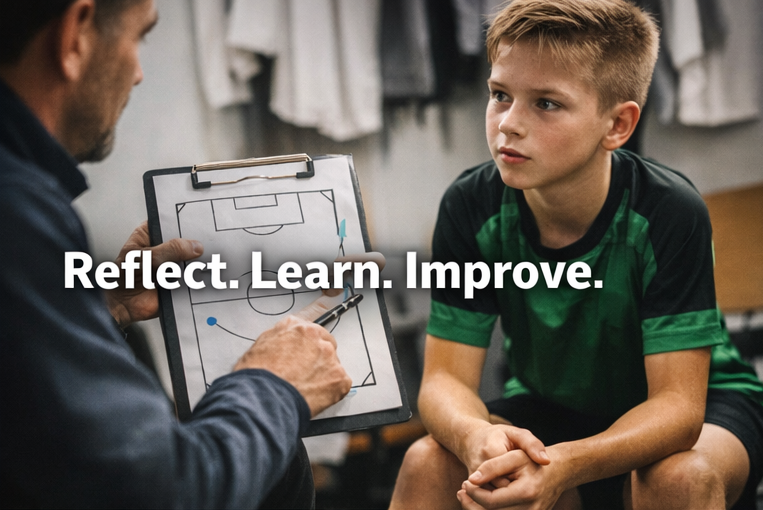
What truly drove change in the study was not just learning content, but reflection. Regular check-ins encouraged participants to notice patterns in their behaviour, identify what worked, and adjust accordingly.
Football already includes feedback, but reflection is often rushed or vague. When players are guided to understand why something happened, learning becomes deeper. They begin to recognise their own tendencies rather than relying solely on instructions from the sideline.
This is where development accelerates. Reflection turns experience into improvement.
Environment Shapes Development
Another important finding was that people improved at different rates depending on their environment. Those in supportive, stable settings progressed faster. Those under pressure still improved, but needed clearer structure and accountability.
Football is no different. Young players develop best when expectations are clear, feedback is consistent, and mistakes are treated as part of learning rather than failure. Talent matters, but environment often matters more.
Understanding this helps explain why some players plateau while others keep growing.
How ProSeed Supports Smarter Development

At ProSeed, development starts with understanding. Rather than guessing why a player is inconsistent, the focus is on making performance visible and explainable.
By looking at how players make decisions, respond under pressure, and adapt over time, development becomes clearer for both players and parents. Progress stops being mysterious. Improvement becomes something that can be tracked, discussed, and supported.
For young players, this builds confidence. For parents, it provides reassurance that growth is not based on chance, but on structure and insight.
A Clearer Path to Improvement
This research reinforces a simple truth. When mindset is trained with intention, reflection, and feedback, performance improves. Not through hype or slogans, but through understanding.
In football, especially at junior level, the goal is not perfection. It is learning how to think, adapt, and grow within the game.
That is the foundation ProSeed is built on: helping players understand themselves better so they can play better — now and in the years ahead.
*Conway, M.J. (2025) Adapting Elite Sport Mindset Techniques for Senior Leadership Development: A Four-Month Online Program Evaluation. Open Journal of Applied Sciences, 15, 3948-3963. https://doi.org/10.4236/ojapps.2025.1512255

Make it stand out
Whatever it is, the way you tell your story online can make all the difference.
